
 Kyle Hudson, Co-Founder & CEO
 Does schema markup help you get cited by AI? What the tests show
Does JSON-LD schema help you get cited by AI? A controlled Ahrefs study and a five-system read test say no. Here's what actually earns citations.
Somewhere on your SEO checklist there is a line that says add JSON-LD everywhere. Product schema on the listings. FAQ schema on the questions page. LocalBusiness schema in the footer. An agency may be invoicing you for it right now, and lately the invoice comes with a new justification: structured data is how AI assistants understand your business.
It sounds plausible. AI systems like structure. Schema markup is structure. Therefore schema markup should help you get cited when someone asks ChatGPT for a recommendation.
Two independent tests from the past year let us check that logic against evidence instead of intuition. They point at the same conclusion, and it is worth stating plainly before the detail: AI systems read your rendered headings and body text. Facts that exist only in schema markup mostly do not get extracted. Keep schema for classic SEO and rich results; put the facts you want cited in the visible text.
Here is what the tests actually showed, where they stop, and what to do with your own pages.
What happens when you add schema to a page AI already cites?
The cleanest evidence comes from a matched-control study by Ahrefs, published from their citation-tracking data. They found 1,885 pages that added JSON-LD schema between August 2025 and March 2026, matched them against 4,000 control pages with similar citation levels that never added schema, and measured citation changes across Google AI Overviews, Google AI Mode, and ChatGPT.
Their summary sentence does the work: "Adding schema produced no major uplift in citations on any platform."
The platform-by-platform numbers, from their difference-in-differences analysis:
Google AI Mode moved +2.4% and ChatGPT +2.2%, both statistically indistinguishable from zero. Noise, in other words.
Google AI Overviews showed a 4.6% decline relative to matched controls. That result is statistically significant but small, and Ahrefs is careful to say they cannot pin it on schema: both groups were already declining together before the schema was added, and other factors could account for the gap. The honest reading is not "schema hurts." It is "schema did not help, and the one negative signal is unexplained."
Ahrefs ran the analysis four different ways (t-test, difference-in-differences, event study, and an alternate time window) and all four agreed: no citation growth on any platform.
One boundary matters for interpreting this. Every page in the study was already being cited heavily by AI before schema was added. So the finding is precise: if a page of yours is already in the consideration set, adding JSON-LD will not push it higher. Whether schema helps a page that AI systems have never picked up is a separate question the study cannot answer, and Ahrefs says so.
Can AI assistants even read schema markup?
The Ahrefs study measures outcomes. A second test, from the German SEO firm searchVIU, measures mechanics: when an AI system fetches one of your pages, what does it actually see?
searchVIU built a test page for a fictional product line and scattered prices across different layers of the page: visible HTML, JavaScript-rendered content, JSON-LD only, hidden microdata, hidden RDFa, and visible microdata and RDFa. Then they asked five AI systems (ChatGPT, Claude, Gemini, Perplexity, and Google AI Mode) to list the products and prices.
The core test was a price that existed only in JSON-LD schema markup and nowhere in the visible page. None of the five systems found it. Not one, across repeated queries.
The pattern across the other layers reinforces the point. Prices in visible HTML were found reliably by ChatGPT and Gemini. Prices in visible microdata and RDFa were found too, because they sit inside text a reader can see. Everything hidden (JSON-LD, hidden microdata, hidden RDFa) was ignored by every system. And only Gemini executed JavaScript during a live fetch; the JavaScript-rendered price was invisible to ChatGPT, Claude, and Perplexity when fetching directly.
The rule that falls out of eight test scenarios is almost embarrassingly simple. When an AI assistant fetches a page to answer a question, it reads what a human would see. The markup layer might as well not be there.
searchVIU flags an important limitation, and it belongs in your mental model rather than a footnote: their tests cover the direct-fetch phase, where a chatbot retrieves a page live to answer a query. Index-based pipelines, like Google AI Overviews and Bing Copilot, work from a search index where structured data is extracted and stored, and may still use schema there. We will come back to that.
If schema does nothing, why do cited pages have so much of it?
Here is the statistic you have probably seen in a conference slide: pages cited by AI are almost three times more likely to have JSON-LD than pages that are not. That figure comes from the same Ahrefs research, from an initial analysis of 6 million URLs, and it is real.
It is also the setup for the whole study. Ahrefs did not trust the correlation, so they ran the matched-control experiment to test it, and the experiment came back empty.
Their explanation for the gap is the one that survives contact with the data: schema markup lives on well-maintained sites. The teams that implement structured data also invest in technical SEO, publish stronger content, build links, keep pages fresh, and rank well in regular search. AI systems retrieve that kind of content for all of those reasons at once. Schema is riding along with the signals that matter, not driving them.
That reframe is useful beyond this one debate. When a tactic correlates with AI visibility, ask whether the tactic causes citations or whether disciplined sites simply do both. Most "AI visibility hacks" circulating right now do not survive that question.
What do Google and Microsoft say about schema and AI?
The counterpoint deserves a fair hearing, because it comes from the platforms themselves.
Google's official guidance on AI features in Search says structured data "isn't required" for generative AI search and there is no special schema.org markup you need to add, while recommending you keep using it where it makes your pages eligible for rich results. Yet Search Engine Land's level-headed review of the schema question collects statements pointing the other way: the Google Search team said in April 2025 that structured data gives an advantage in search results, and Microsoft's Fabrice Canel confirmed in March 2025 that schema markup helps Bing's LLMs understand content for Copilot.
Those statements are compatible with the test results once you separate the phases. Schema is extracted at indexing time by Google and Bing, and systems built on those indexes may benefit from it in ways the direct-fetch tests cannot see. What no one has produced is a controlled study showing schema lifting AI citations; Search Engine Land notes that no peer-reviewed studies on schema's impact on AI search visibility exist yet.
So the fair summary is not "schema is dead." It is: schema helps the two ecosystems that have publicly committed to using it, in the classic ways (rich results, entity understanding), and the measurable AI-citation payoff that vendors promise has not shown up in any test that controlled for other factors.
The Visible-Text test
All of this compresses into one question you can ask about any fact on any page. We call it the Visible-Text test:
If every line of markup were stripped from this page, would the fact still be there?
If yes, every AI system in the searchVIU test could potentially read it. If no, none of them could. That is the whole framework, and it is deliberately blunt, because the failure mode it catches is common: teams encode their most valuable facts (prices, service areas, hours, credentials, what makes them different) into structured data, feel finished, and leave the visible page vague.
Here is where specific kinds of facts belong:
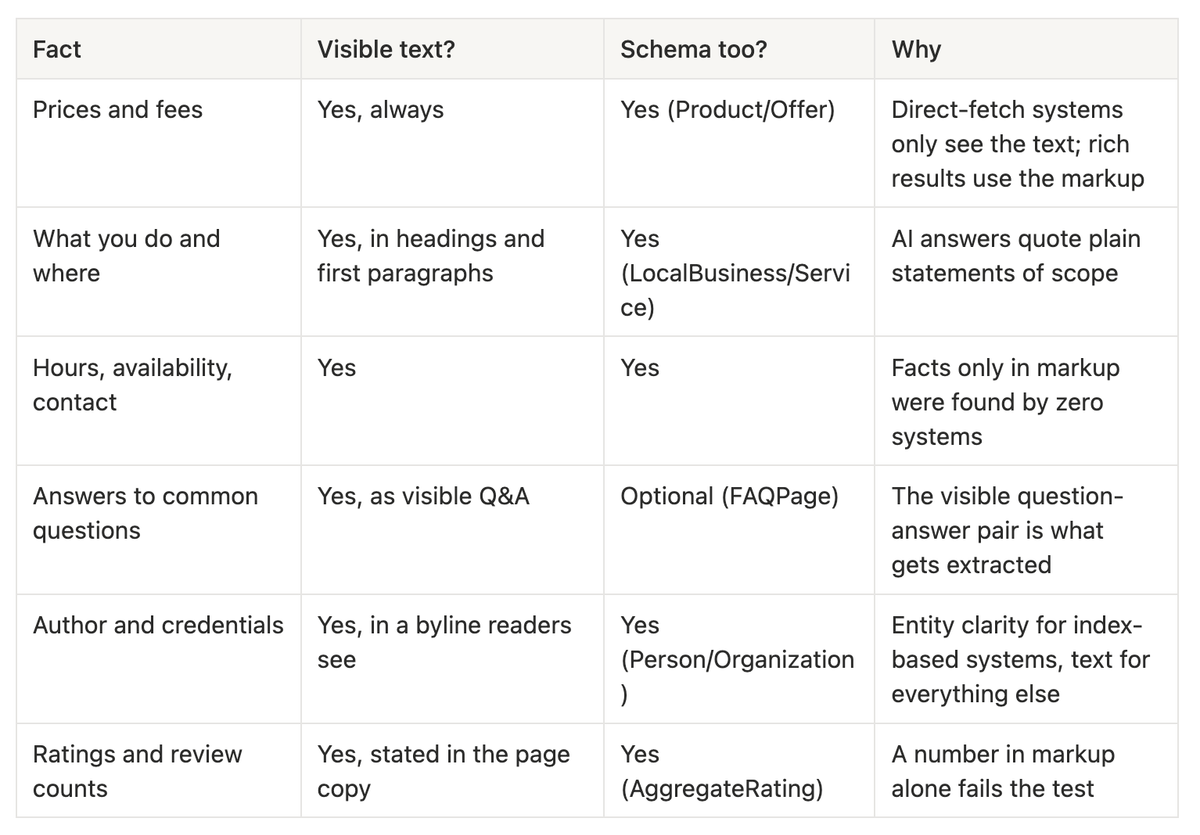
Notice the pattern in the middle column. The answer is never "markup instead of text." Schema stays in the picture for rich results and for the index-based systems that use it. It just never gets custody of a fact on its own.
How do you apply this to your own pages?
A practical pass, page by page:
First, list the facts you would want an AI assistant to state about you: what you do, where, for whom, at what price, and why you over the alternative down the street.
Second, open each important page and apply the Visible-Text test to each fact. View the rendered page the way a visitor sees it. Anything that lives only in JSON-LD, only in a meta tag, or only behind a JavaScript interaction fails.
Third, move failing facts into headings and body text. Specific beats clever: "Property management for short-term rentals in Sarasota, with published monthly pricing" is extractable; "solutions tailored to your needs" is not.
Fourth, keep your schema, but demote it to its real job: rich results, entity clarity for Google and Bing, and clean machine-readable confirmation of what the text already says. Never let the markup contradict the page.
Fifth, measure instead of guessing. Ahrefs suggests a self-test: pick a handful of pages, add schema to some and not others, and compare citation changes over 30 days. For the tracking layer, this is what we use Peec for: set up prompts your customers actually ask, watch which of your pages get cited across engines, and compare before and after a content change. If citations move when you rewrite visible text and stay flat when you add markup, you have reproduced both studies on your own site, with your own data.
This mirrors how we think about structure at Stacklist. When a real estate agent builds a branded content hub, every stack and card renders as plain, crawlable text on the page: the restaurant recommendation, the note about why this inspector and not that one, the neighborhood context, all visible. The structure helps machines parse it, but no fact lives in a hidden layer. You can build the same discipline into any website; the test is whether a view-source stranger and a screen reader get the same facts a visitor does.
What this won't tell you
The honest boundaries of the evidence:
These tests cover retrieval-time reading. Whether schema influences model training data or index-side ranking is not something either study can see, and the platform statements suggest index-side use is real for Google and Bing.
The Ahrefs result applies to pages already being cited. For a page AI systems have never retrieved, nobody has shown whether schema helps or does not help it get picked up in the first place.
The small AI Overviews decline is unexplained. Do not act on it. There is no evidence-backed reason to remove schema you already have.
Schema types were pooled. It is possible some specific types matter more than others; that has not been tested separately.
And this is a fast-moving area. The searchVIU tests ran in October 2025; the Ahrefs window closed in March 2026. Retrieval systems change quietly and often. The Visible-Text test is robust to that in one direction only: visible text is readable by every system today and every system likely to exist, while markup-only facts depend on implementation details you cannot verify.
Here's what to check, in order
- List your citable facts. Prices, scope, location, hours, credentials, differentiators. If an AI answer got one of these wrong, which would cost you a customer first?
- Run the Visible-Text test on your five most important pages. Would each fact survive if all markup were stripped? Fix the failures by writing the facts into headings and body text.
- Check your JavaScript dependence. If key facts render only client-side, most direct-fetch systems never see them. Get them into the server-rendered HTML.
- Audit your schema for contradictions, not coverage. Keep it for rich results; make sure it confirms the visible text rather than replacing or contradicting it.
- Stop paying for schema as an AI-visibility lever. If a proposal promises AI citations from markup alone, ask for the controlled evidence. As of now, it does not exist.
- Set up measurement before your next content change. Track prompts and citations in Peec (or log answers manually across engines) so you can attribute movement to the change you made, not the tactic you were sold.
The markup was never the message. The page is.
We collected the studies, platform statements, and a page-by-page on-page checklist into a companion stack you can work through against your own site: