
 Kyle Hudson, Co-Founder & CEO
 How AI actually answers "best X in [town]": fan-out queries, explained
One question to an AI assistant becomes dozens of hidden searches. Here's how query fan-out works, and how hyper-specific content wins those queries.
A buyer new to town asks ChatGPT where to get coffee quiet enough for a work call. The answer comes back in seconds: three specific shops, each with a reason attached. Fast Wi-Fi at one. Big tables and outlets at another.
Now picture the business owner reading that answer. A real estate team, a boutique hotel, a short-term rental manager: anyone whose value comes from knowing a place well. You rank on Google for your head term. You keep a website, reviews, maybe a hub of neighborhood guides. And when someone asks an assistant for a recommendation in your category, your name never comes up.
That result is not random. There is a specific, documented mechanism deciding which names make it into the answer, and once you can see it, you can work with it.
What actually happens when someone asks for a recommendation?
The question does not go straight to a model reciting things it memorized during training. Modern AI search retrieves live pages first, then writes the answer from what it retrieved.
Google spells this out in its official guidance for site owners, Optimizing your website for generative AI features on Google Search. Two mechanisms matter:
Retrieval-augmented generation (grounding). The system pulls relevant, up-to-date pages from the search index, reads them, and generates a response with links to the pages that support it. Google notes these AI features are "rooted in our core Search ranking and quality systems."
Query fan-out. Google defines it as "a set of concurrent, related queries generated by the model to request more information and fetch additional relevant search results to address the user's query." Their example: ask "how to fix a lawn that's full of weeds," and the system may also run "best herbicides for lawns," "remove weeds without chemicals," and "how to prevent weeds in lawn."
So one visible question becomes many hidden searches. Each hidden search pulls its own set of pages. The model reads across all of them, writes one answer, and cites the pages it leaned on.
How many sub-queries does one question trigger? Google does not publish a count, and it likely varies by question. The mechanism matters more than the number: your one question fans out into a family of more specific ones.
Why is ranking once no longer enough?
Traditional SEO trained everyone to think in head terms. Win "coffee shops [town]" or "[town] real estate agent," and the traffic follows.
Fan-out breaks that model. The assistant answering the coffee question never ran only "coffee shops [town]." It also ran something like "coffee shops with fast Wi-Fi [town]," "quiet cafes for working [town]," "cafes with outlets near downtown." Whoever published the page that cleanly answers each specific sub-query gets pulled into the answer. The head-term champion can lose to five specialists it has never heard of.
This is why hyper-specific content reaches sub-queries that generic content never touches. A page titled "Work-friendly coffee shops in [neighborhood] with fast Wi-Fi" maps directly onto a fan-out query. A generic "Top 10 coffee shops" listicle maps onto nothing in particular.
Google makes the same point about content quality. Its guide contrasts commodity content, "something like '7 Tips for First-Time Homebuyers'," which could originate from anyone, with non-commodity content such as "Why We Waived the Inspection & Saved Money: A Look Inside the Sewer Line": a first-hand, specific take that stands out when AI systems look across sources. If you sell local expertise, that second title is the shape of what wins.
And the engines keep coming back for it. The pattern is the one Google documents: retrieval systems repeatedly fetch fresh, specific pages to ground new answers, so a maintained resource gets re-read on a regular basis rather than crawled once and forgotten.
What is the Fan-Out Ladder?
Think of the path from a stranger's question to your name in the answer as a ladder with four rungs. We call it the Fan-Out Ladder.
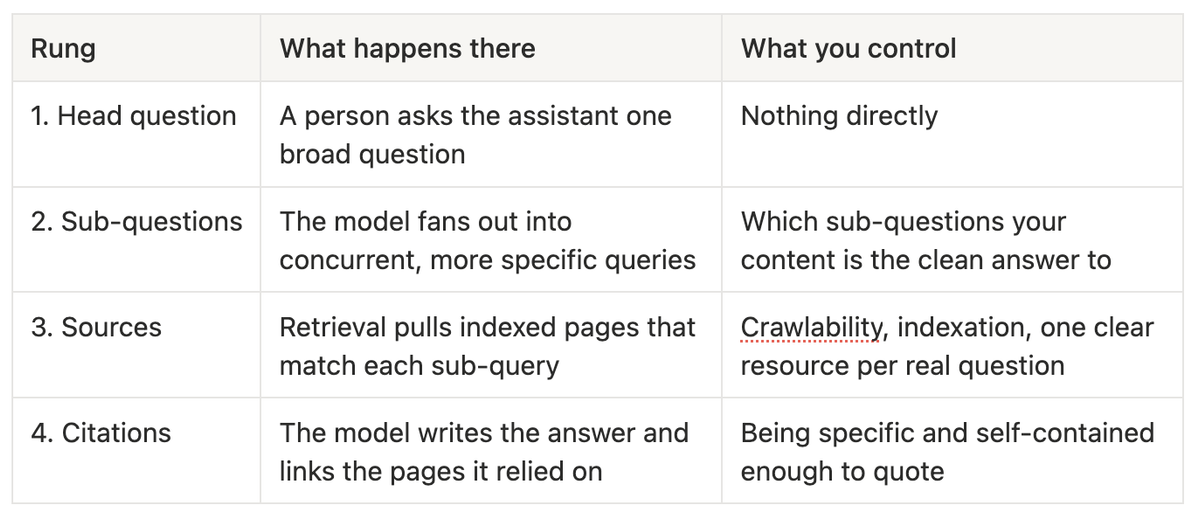
You cannot win at rung 1. There is no single ranking to seize anymore, because the question you would rank for is immediately decomposed. You win at rungs 2 and 3: identify the sub-questions you can genuinely answer, and make sure a specific, crawlable resource exists for each one. Rung 4 follows from doing rungs 2 and 3 well.
How do you find the sub-queries you could own?
You can run this exercise in an afternoon with the assistants you already have open.
- Write down your head questions. List five to ten questions a customer would actually ask out loud. "Best neighborhoods for families moving to [town]." "Where should I stay in [town] for a long weekend." Real phrasing, not keywords.
- Generate the likely fan-out. Ask the engine to show you its decomposition. A copy-paste prompt:
I run a [business type] in [town]. For the question "[head question]", list the specific follow-up search queries a search system would run to answer it well. Include constraints (price, timing, location), comparisons, and situational variants. Group them by intent.
Run it in two or three different assistants. The sub-queries that appear in every list are your working map. Treat it as an approximation, not a transcript of the real system. - Ask the head question for real and log who gets cited. Ask each assistant the actual question your customer would ask. Write down every business named and every URL cited. This is your competitive baseline.
- Map sub-questions to your content. For each sub-query in your map, mark one of three states: you have a strong, specific resource; the answer exists but is buried inside a long general page; or you have nothing. The "buried" and "nothing" rows are your white space.
- Publish real answers, not variants. One caution, straight from Google: producing separate content for every possible query variation primarily to manipulate rankings or AI responses violates its scaled content abuse spam policy, and a high quantity of pages does not make a site more relevant. The play is narrower and more honest: for each sub-question where you have genuine first-hand knowledge, publish one useful, self-contained resource. Specific beats voluminous. This is the workflow a branded content hub is built for. A real estate agent on Stacklist, for example, answers each sub-question as its own curated stack: work-friendly coffee shops with fast Wi-Fi, schools near a specific neighborhood, restaurants that seat large groups. Each stack is one specific, browsable, crawlable answer, and the hub holds them together under the agent's name. The sources behind this guide are collected the same way:
- Keep watching. Recommendations shift as engines re-retrieve. A tracking tool like Peec runs your prompt list daily across engines and logs when your brand is mentioned and which URLs get cited, so you can watch a specific sub-question flip from absent to cited after you publish. A spreadsheet and a monthly hour of manual prompting works too. The discipline matters more than the tool.
What this won't do
Honest limits, so you spend effort where it pays.
This method will not show you the real sub-query list. Engines do not publish their fan-out, and the decomposition you generate in step 2 is an educated approximation that will drift over time.
It will not rescue a site that retrieval cannot reach. Google is explicit that a page must be indexed and eligible to appear with a snippet before any generative AI feature can surface it. Fix crawlability before chasing sub-queries.
It will not work as mass production. Spinning up a thin page per query variation is the exact behavior the spam policy targets, and it fails on its own terms: commodity content loses to first-hand specificity.
And it will not guarantee citations. Answers vary between runs, engines weigh sources differently, and a competitor with a sharper resource can displace you. What you control is coverage and quality at rungs 2 and 3 of the ladder, not the final sentence the model writes.
Here's what to check, in order
- Are you indexed and snippet-eligible? Verify in Search Console before anything else.
- Have you written down your five to ten real head questions?
- Have you generated a fan-out map for each, across at least two assistants?
- Have you asked the head questions for real and logged who gets named and cited today?
- Which sub-questions can you genuinely answer that have no specific, self-contained resource yet?
- Have you published one real resource per real question, starting with the emptiest white space?
- Are you re-checking mentions and citations on a schedule, with a tool or a spreadsheet?
The buyer asking about quiet coffee shops was never going to find a homepage. They were going to find whoever answered the specific question the machine actually asked. Be that answer, several times over.
We collected every source and tool referenced in this guide as a browsable companion stack: