
 Kyle Hudson, Co-Founder & CEO
 Who owns your AI visibility? The rented-space question, answered honestly
Building your expertise on someone else's platform feels risky. Here's an honest Portability Checklist for evaluating any platform before you build there.
You are about to put your expertise somewhere public. Maybe a branded content hub. Maybe a newsletter platform, a YouTube channel, a directory listing. And right on schedule, someone repeats the oldest advice on the internet: never build on rented land.
The logic sounds airtight. If the platform changes its rules, raises its prices, or shuts down, everything you built goes with it. So the safe move seems obvious: publish only on the domain you own, and treat everything else as a billboard.
That advice is not wrong. It is incomplete, and the incomplete version quietly costs people years of visibility. This guide takes the objection seriously, answers it honestly, and leaves you with a checklist you can run against any platform before you build there. Including ours.
Why does everyone say "never build on rented land"?
Because people have been burned, repeatedly and publicly.
Businesses spent years building audiences on social platforms, then watched organic reach get turned down like a thermostat. Companies built entire products on third-party APIs that closed. Directories and marketplaces have folded and taken every listing with them. The pattern is always the same: you invest in a surface you do not control, the rules change, and the asset you thought you were building turns out to have been a lease you thought was a deed.
So the standard counsel hardened into a slogan: own your domain, own your list, own your content.
Two of those instincts are genuinely worth keeping. Owning a domain means your URLs survive a platform's death, because you can point them somewhere new. And owning your audience relationships, like an email list you can take with you, means no algorithm sits between you and the people who chose you.
Hold onto those. The rest of the slogan deserves more scrutiny than it usually gets.
What does owning your domain actually buy you?
Less than the slogan implies.
Your domain is a deed to an address, not to the traffic that reaches it. Whether anyone finds that address is decided by systems you do not control: search indexes, AI answer engines, social distribution, email inbox filters. You own the building. Someone else owns every road that leads to it.
And the authority attached to your domain is itself slow to build and surprisingly fragile to hold. Kyle Hudson, Stacklist's founder, puts it plainly: the authority people think they own behaves like rented authority too.
"The rented authority is also fragile. That domain authority is actually strongly moving up or down in any one direction only if you're writing a ridiculous amount of blogs and have a ridiculous amount of content on your website."
In other words, owned-domain authority is not a vault. It is a treadmill. A small business website that publishes a handful of pages a year is not a fortress of owned equity. It is a low-signal surface that indexing systems have little reason to revisit, competing against every established domain in its category for the same questions.
None of this means your own domain is a bad investment. It means "I own it" is not the same as "it is safe," and it is definitely not the same as "it is visible."
Isn't every distribution surface rented anyway?
Yes. And it is worth saying this bluntly, because the "rented land" warning is usually delivered by people standing on rented land.
Your accounts on social platforms are rented. Your business listing on review platforms is rented. Your YouTube channel, your podcast's spot in every directory, your marketplace storefront: rented, rented, rented. Even the "owned" stack rents most of its layers. Your hosting is a vendor. Your CMS is a vendor. Your email deliverability depends on inbox providers who owe you nothing. And your discoverability, the thing this whole argument is about, is granted or withheld by search and AI answer engines that never signed a contract with you.
Once you see this, the question changes shape. "Owned or rented?" stops being useful, because almost everything is rented. The useful question is the one a good tenant asks before signing anything: what does the lease actually say?
That question has real answers, and you can get them before you invest a single hour of writing.
How do you evaluate a platform before you build on it?
Run the Portability Checklist: six diligence questions that separate a surface worth renting from a trap. They apply to any platform, whether it is a hub on Stacklist, a newsletter service, a video channel, or a directory.
- Can you get everything out? Not "is there technically an export somewhere," but: can you download your content in a structured, reusable format, on your own schedule, without asking support?
- Can your own domain point at it? Custom-domain support means the URLs, and any authority they accumulate, can survive the platform. Without it, every link anyone builds to your work belongs to the landlord.
- What happens the day you cancel? Do your public pages stay up in some form, redirect somewhere you control, or vanish? A platform that answers this in writing is telling you it has thought about your exit. Silence is also an answer.
- Is your work on the open web? Content behind a login wall cannot be crawled, indexed, or cited by anything. If assistants and search engines cannot read it, it builds you no visibility while you rent.
- Where does the authority accrue? When your work gets cited, is it your name and your URL earning the citation, or the platform's generic aggregate page? Reviews are the classic failure here: years of five-star proof that accrues to the review platform's domain, not yours.
- Does the surface compound or decay? Feed-shaped surfaces bury your work within days. Structured, browsable surfaces keep serving it for years. You want rent that buys appreciation, not rent that buys a moment.
For quick reference:
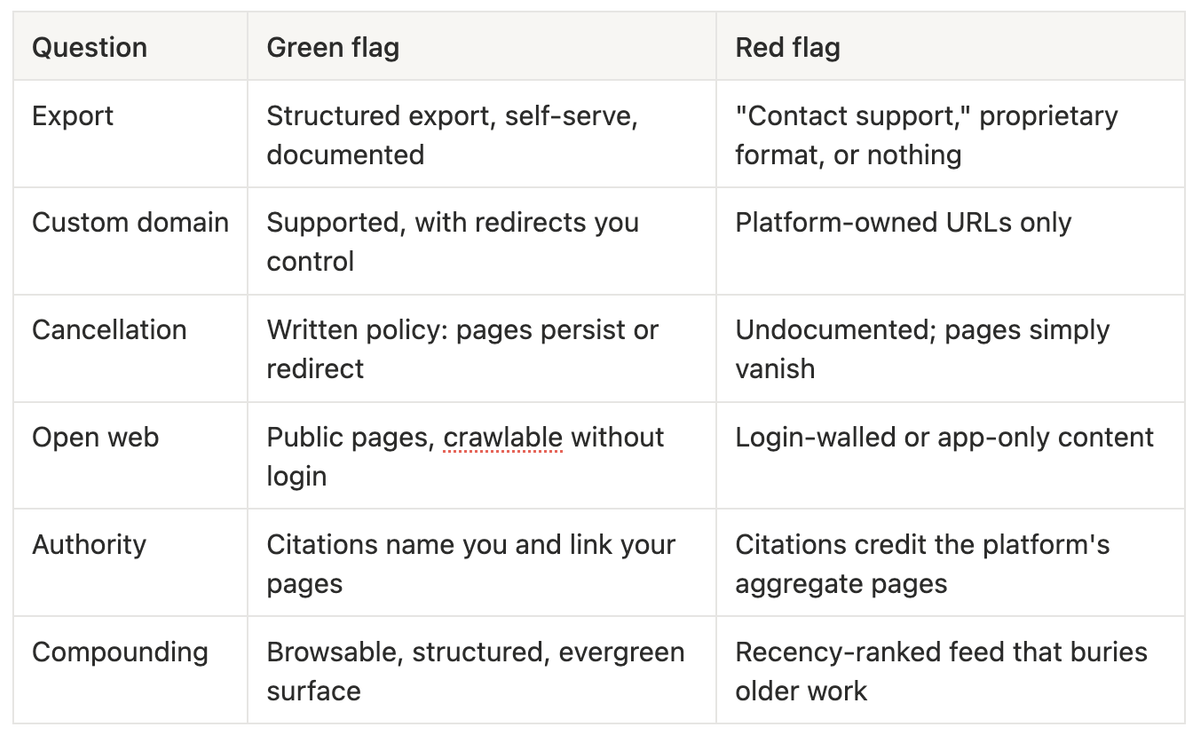
A surface that passes all six is rented space with a good lease. A surface that fails the first three is a trap no matter how much traffic it promises.
How do you check whether a surface is compounding while you rent it?
The sixth question is the one you cannot answer by reading a pricing page. You have to measure it.
The method: pick ten to twenty questions your customers actually ask an AI assistant, the ones you want to be the answer to. Set them up as tracked prompts in Peec, which runs them on a daily cycle across the major engines and logs which brands get mentioned and which URLs get cited. Then watch the cited sources over a few weeks.
What you are looking for is simple. When an answer to one of your questions cites a source, is it one of your surfaces? Your website, your hub, your YouTube channel? If a rented surface keeps earning citations under your name for the questions you care about, it is compounding for you while you rent it. If the only thing being cited is the platform's own generic pages, the rent is buying the landlord's visibility, not yours.
This turns the rented-space debate from a philosophical argument into a dashboard you can check. A surface either shows up in the citation log or it does not.
How does Stacklist answer its own checklist?
Stacklist sells rented space. Hubs, stacks, and cards live on Stacklist's infrastructure, so this checklist applies to us as much as to anyone, and it would be strange to publish it without answering it.
Here is where we stand, stated only as far as we can verify publicly today:
- Open web: yes. Hubs and the stacks inside them are public pages on the open web, readable without an account. That is the whole design: curation that crawlers and assistants can actually reach.
- Compounding: structurally, yes. A hub is a browsable, organized surface, not a recency-ranked feed, so a stack built two years ago is as reachable as one built yesterday. Whether it compounds for you still depends on the quality of what you put in it.
- Custom domain: yes. A hub can be reached at a domain you own, not just a stacklist.com URL — so the links people build to your work, and the authority those links accumulate, belong to you.
- Export: not yet, as a dedicated feature. There's no one-click "export everything" button today. What exists in the meantime: our MCP integration lets you connect Stacklist to Claude or other AI assistants and work with your stacks programmatically, the browser extension and web interface let you manage and pull content manually, and mobile shortcuts give quick access on the go. None of that is a substitute for real self-serve export, and we're not going to pretend it is.
- Cancellation: undocumented. We don't have a published policy yet for what happens to a hub's public pages if a subscription ends. That's a gap, not a decision we're hiding.
Those last two rows are deliberate to leave unresolved rather than paper over. We would rather show you the unanswered rows than imply answers we haven't verified in writing. And, naming them here is also how we keep ourselves honest about what to build next.
The standard we're asking you to hold us to is the same one you should hold every platform to: if a company selling you space can't answer the export question in one sentence, that's your answer. Ours, for now, is "not yet, but here's what you can do instead."
What won't this checklist do for you?
Be clear about the limits before you rely on it.
It will not make the ownership question disappear. Portability is a parachute, not a pension. If a platform fails, a good export still leaves you with the work of rebuilding somewhere else.
It will not protect you from your own neglect. A perfectly portable surface full of stale content fails the compounding test anyway. The maintenance obligation travels with you, rented or owned.
It will not tell you where your customers are. A platform can pass all six questions and still be the wrong place because nobody you serve looks there. Diligence on the lease is separate from diligence on the neighborhood.
And its answers expire. Platforms change export policies, domain support, and cancellation behavior. A checklist you ran in 2024 says nothing about 2026. Re-run it roughly once a year on every surface you depend on.
Here's what to check, in order
- Keep the two real assets of ownership: a domain you control and an audience list you can take with you. Nothing below replaces them.
- List every surface where your expertise currently lives: website, hub, channels, directories, marketplaces. Label each one honestly as what it is: rented.
- Run the Portability Checklist against each surface: export, custom domain, cancellation, open web, authority, compounding.
- Kill or downgrade any surface that fails the first three questions and holds work you cannot afford to lose. Get an export out this week.
- Set up tracked prompts in Peec for the questions you want to own, and watch which of your surfaces earn citations over a full cycle.
- Keep renting the surfaces that pass and that show up in the citation log. Rent with a good lease and visible compounding is not a risk. It is distribution.
- Put a reminder in your calendar to re-run the checklist in a year. Lease terms change.
The rented-land warning got one thing permanently right: read the lease before you build. It got the conclusion wrong. You cannot avoid renting, because everyone rents, including the people who tell you not to. The question was never whether you rent. It is whether you can leave with your work, and whether the space works for you while you are there.
We have put the full checklist, with the green and red flags for each question, into a companion stack you can keep and reuse for every platform decision: