
 Kyle Hudson, Co-Founder & CEO
 Atomic content: why AI cites collections, not pages
AI engines don't cite whole pages, they cite passages. Here's how to restructure your best content into self-contained atomic units that get quoted.
You publish every week. A blog post, a newsletter, a round of social updates. The calendar is full, the archive is deep, and by any traditional measure you are doing content right.
Then someone asks ChatGPT for a recommendation in your exact specialty, and the answer cites a directory, a forum thread, and a competitor who publishes a fraction of what you do. Your two-thousand-word guide on that exact topic never comes up.
The instinct is to publish more. The problem is not volume. It is shape. AI engines do not cite bodies of work. They cite discrete, self-contained answers they can lift cleanly out of a page. Most long-form content, however good, is not built in liftable pieces. This guide covers what that means and how to restructure what you already have.
Why does AI search skip long pages?
Start with how these systems actually read a page, because it is more literal than most people assume.
When an AI engine fetches a page to answer a question, it parses the visible rendered text. In an October 2025 test by searchVIU, a test page carried product prices in several places: plain visible HTML, JavaScript-rendered content, and hidden structured markup (JSON-LD, Microdata, RDFa). Across ChatGPT, Claude, Gemini, Perplexity, and Google AI Mode, not one system extracted information that lived only in hidden JSON-LD markup during a direct fetch. What the systems reliably used was the content a human could see on the page.
Google says something similar in its official guidance on AI features in Search: structured data is not required for generative AI search, and there is no special markup that gets you in. The content itself has to carry the answer.
So picture your long guide through that lens. The specific answer someone needs sits in paragraph fourteen. It leans on context established six paragraphs earlier. The subhead above it is clever rather than descriptive. A human reader who is already committed will get there. A machine assembling an answer from twenty sources in two seconds will take the page that states the answer plainly, in one place, with its context attached.
That is the whole game. The unit of citation is not the page. It is the passage the engine can extract without doing archaeology.
What is atomic content?
Atomic content is the practice of structuring knowledge as small, self-contained units that each answer one question completely, instead of long pages where many answers share one pool of context.
Call the framework what it is: Atomic Content. A content atom has four properties.
- One question. The unit exists to answer a single question a real person would ask. Not a theme, not a topic area. One question.
- One answer. The unit answers that question completely. A reader (or a machine) who sees only this unit gets the full answer, not a teaser pointing somewhere else.
- Its own context. The unit carries the who, where, and when inside itself. "The best patio for a work meeting" is not self-contained. "The best patio for a work meeting in Alpharetta, as of summer 2026, if you need reliable Wi-Fi" is.
- Machine-readable relations. The unit is visibly connected to its siblings: part of a named collection, linked to related units, attributed to an author. The connections are in the rendered content, not buried in markup no engine reads at fetch time.
Here is the anatomy as a quick reference:
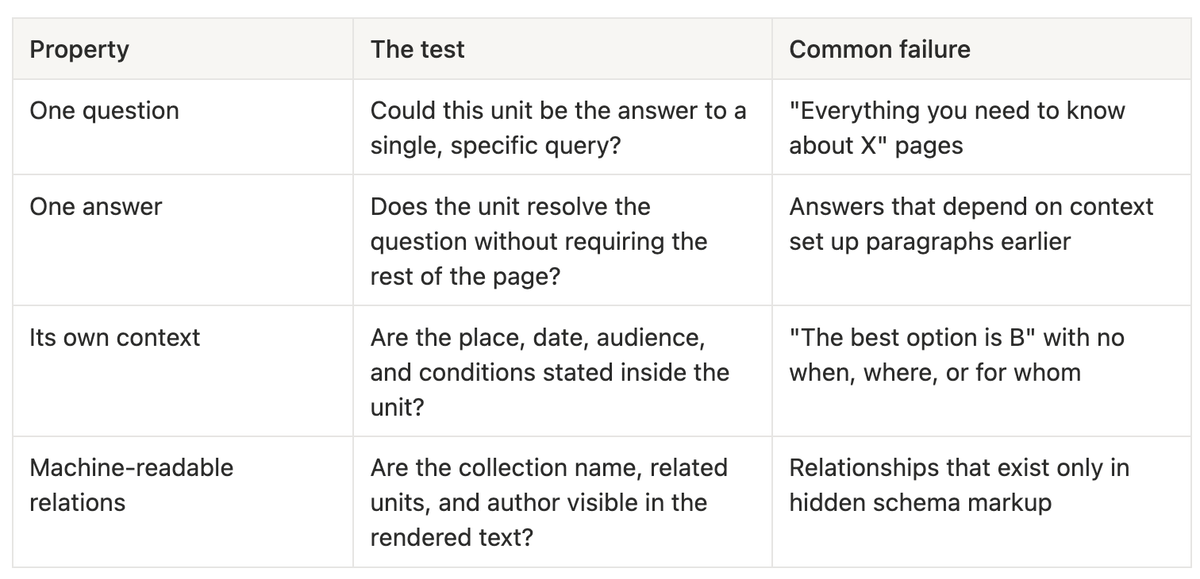
Notice what is not on the list: length. An atom can be forty words or four hundred. What matters is that its edges are clean. You should be able to cut it out of the page with scissors and have it still make sense.
There is a reason this shape wins beyond extraction cost. A specific, contextualized unit maps to specific questions. "Coffee shops in Roswell with fast Wi-Fi and seats near outlets" matches a real query that a generic "our favorite local coffee shops" roundup never touches. Atomizing does not just make your content easier to lift. It multiplies the number of questions you are eligible to answer.
How do you atomize a page you already published?
You do not need to write new material. Your long-form archive is raw ore. Here is the process for one page.
- List the questions the page actually answers. Read your guide and write down every distinct question it resolves. A typical 2,000-word guide answers eight to fifteen. Each one is a candidate atom.
- Split the content along those lines. Give each question its own unit with a plain, descriptive heading, phrased the way a person would ask it. "How much should I budget for a kitchen remodel permit in Fulton County?" beats "Permits and paperwork."
- Repatriate the context. This is the step people skip. Each unit inherited context from the page around it: the city, the year, the type of reader, the caveats. Move that context inside each unit, even though it feels repetitive. Repetition across units is a feature. Each atom has to survive alone.
- Make the relations visible. Name the collection the units belong to. Link sibling units to each other in the body text. Put the author's name and credential where an engine fetching the page can read it. Remember the searchVIU finding: if a relationship exists only in hidden markup, at fetch time it does not exist.
- Keep everything in rendered, visible text. No answer should live only in a tab, an accordion that requires interaction, or a script-injected element. If a human with JavaScript disabled and no patience cannot see it, assume an engine cannot either.
- Republish the long page as a hub for the atoms, not a replacement. The narrative version still serves human readers who want the full arc. The atomic version serves everyone who arrives with one question, including the machines.
One way to run steps two through four without hand-building templates is a branded content hub. This is what we built Stacklist around: each recommendation or answer becomes a card, cards carry their own titles, notes, and source links, and cards group into stacks that name the collection explicitly. The structure does the atomizing for you, and the relations between card, stack, and hub are part of the rendered page rather than an afterthought.
The shape pays off in machine terms, too. When we designed an atomic format for AI agents and benchmarked it as the open-source Atomic Content Protocol, the atomized structure let agents read the same content with an 84% token reduction against the raw page. Less work to read means more likely to be read. But the principle matters more than any product: a well-structured FAQ page, a glossary, or a directory of short answer pages gets you the same fundamentals.
How do you know it's working?
Atomization is testable. Before you restructure, run ten questions your content should answer through the engines your customers use and log whether you appear. After the atomic version has been live and indexed for a few weeks, run the same ten.
If you want this continuous instead of manual, a monitoring tool like Peec does the same loop daily: you register the prompts once, and the dashboard shows your visibility per prompt, which URLs the engines retrieved, and which sources got cited instead of you. The before-and-after on a restructured page is exactly the comparison it is built for. The manual spot check works fine on its own; tooling just removes the discipline problem.
What atomic content won't do
Honest scoping, because restructuring is real work and it is not a cure-all.
Atomic content will not create demand. If nobody asks questions in your niche, no structure makes you citable. It will not substitute for expertise: an atom containing a generic answer is a well-shaped empty box, and engines lean toward sources with a genuine point of view. It will not fix crawlability. If your pages are slow, blocked, or unindexed, shape is irrelevant because nothing is being read in the first place. And it will not produce overnight results; engines revisit and re-index on their own schedule, so judge the experiment in weeks, not days.
It is also not a markup trick. Nothing here involves adding schema in hopes of a shortcut. The evidence points the other way: the answer has to be in the visible text.
Here's what to check, in order
- Pick your single best long-form page and list every question it answers.
- Run those questions through two or three AI engines and log whether you are cited today. That is your baseline.
- Split the page into atoms: one question, one complete answer, descriptive heading each.
- Move context inside every unit: place, date, audience, caveats.
- Make collection names, sibling links, and authorship visible in the rendered text, not just in markup.
- Verify every answer survives with JavaScript off and no clicks.
- Keep the narrative page live and link it to the atoms.
- Re-run your baseline questions after a few weeks, by hand or with a tracker like Peec, and compare.
The archive you already have is not wasted. It is just stored in a shape machines cannot quote. Change the shape, and every question you have ever answered becomes a page one candidate for the exact person asking it.
To see the difference side by side, we took one long blog post and rebuilt it as a stack of atoms:
Browse both versions and ask your favorite assistant about them. The comparison makes the argument better than we can.