
 Kyle Hudson, Co-Founder & CEO
 Run your own AI visibility audit in an afternoon
There's no Search Console for ChatGPT. Here's how to run your own AI visibility audit in an afternoon, using nothing but a spreadsheet and a browser.
Somewhere this week, a potential client asked ChatGPT which real estate agent to call in your town. Someone asked Perplexity for a property manager who actually handles short-term rentals well. Someone asked Gemini what to fix before listing a house.
You were either in those answers or you weren't. Right now, you probably don't know which.
You have invested in a website, a Google Business Profile, maybe a branded content hub with your local knowledge organized into stacks. What you don't have is a report that says: here is what the answer engines say when your future clients ask about you, your competitors, and your market.
You can build that report yourself, in an afternoon, with a spreadsheet and a browser. This guide shows you how, and what to do when the answer comes back zero.
Why is this worth an afternoon now?
Two reasons.
First, the mechanics are knowable. Google's own guidance for AI features says its generative experiences are "rooted in our core Search ranking and quality systems," and describes how a single question gets expanded into a set of concurrent, related sub-queries, which Google calls query fan-out. One conversational question becomes many specific searches under the hood. That means your visibility isn't one rank on one keyword anymore. It's a scatter of presences and absences across hundreds of specific questions, and you can sample it.
Second, nobody hands you the data. There is no Search Console for ChatGPT. If you want to know whether an answer engine mentions you, you have to ask it and write down what it says. The good news: that is a completely learnable, repeatable exercise.
What is the Audit Loop?
The method is a four-step cycle. We call it the Audit Loop: derive prompts, run and log, score presence, find gaps. Then repeat on a schedule, because answers drift.
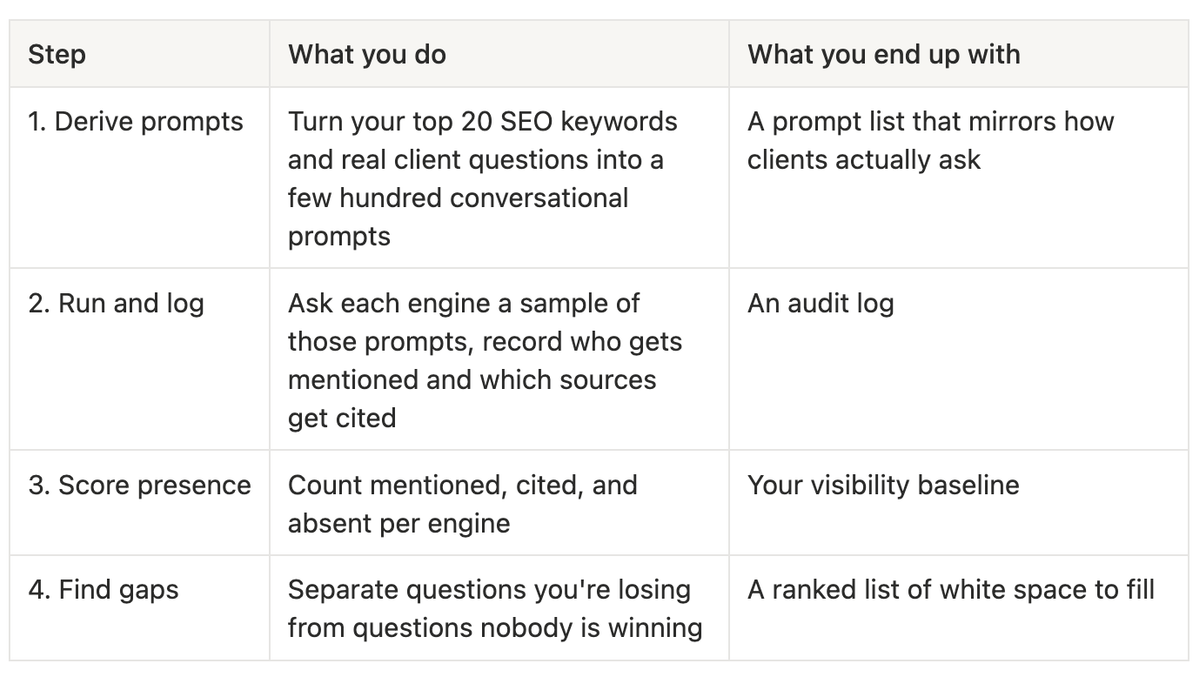
Each step is below, with the exact moves.
Step 1: which prompts should you test?
Start with what you already know works. Pull your top 20 SEO keywords: the queries that bring people to your website today. Those keywords are proof of demand. Your job is to translate each one into the conversational forms a person would use with an answer engine.
For each keyword, write variants across four patterns:
- Recommendation: "Who is a good listing agent in Marietta for a first-time seller?"
- Comparison: "Should I use a big brokerage or an independent agent to sell in Marietta?"
- Situation: "We're relocating to Marietta with two kids and a dog. Where should we look, and who can help?"
- Hyper-specific: "Which Marietta neighborhoods have the shortest commute to Midtown and good schools?"
Twenty keywords, expanded roughly ten ways each, gets you to about 200 prompts. That sounds like a lot. It's the point: because engines fan a broad question out into many specific sub-queries, a broad audit has to sample many specific questions to see the real picture.
Then add the second source: real client questions. Go through your inbox, your call notes, your showing conversations. The questions clients ask you directly are the same questions other people ask a chat window when they don't have you yet. These are often better than anything you'd derive from keywords, because they carry the situation with them.
Write everything into one sheet. One prompt per row.
Step 2: how do you run the prompts and log the answers?
You will not run all 200 in an afternoon, and you don't need to. Sample 40 to 60 prompts across your categories: enough to see patterns, small enough to finish today.
Run each prompt in at least three engines. A reasonable spread:
- ChatGPT
- Google AI Mode or AI Overviews
- Perplexity
- Gemini
- Claude
Use fresh sessions where you can, so your own history doesn't color the answers. Ask the prompt exactly as written. Then log three things before moving on:
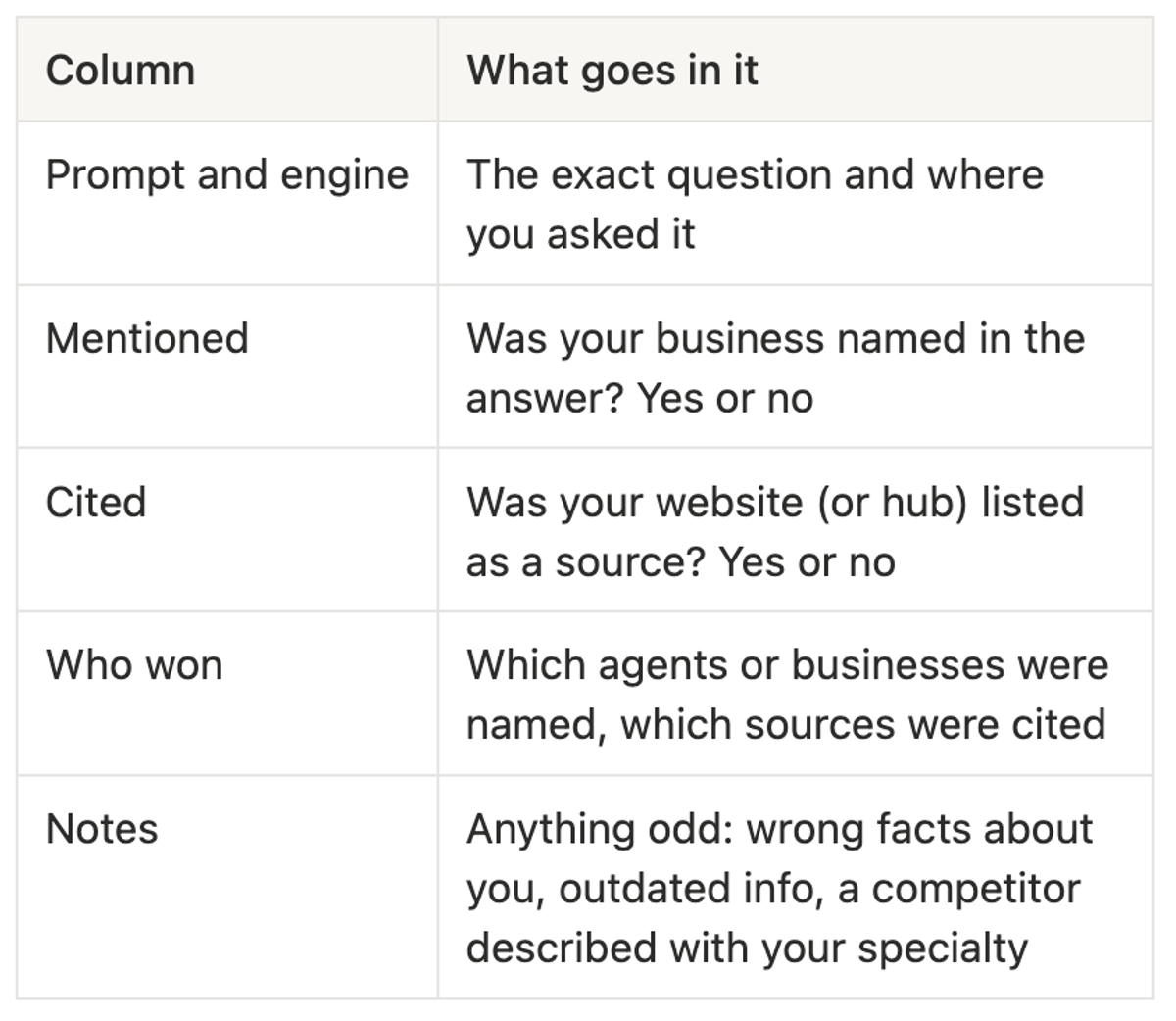
The "who won" column matters as much as your own row. You are not just auditing yourself. You are mapping who the engines currently trust on your turf.
Step 3: how do you score what comes back?
Every prompt-engine pair lands in one of three buckets:
- Cited. Your content is listed as a source. This is the strongest position: the engine is not just aware of you, it's sending readers to you.
- Mentioned. You're named in the answer, but nothing of yours is cited. You exist to the engine, but it learned about you from someone else's page.
- Absent. Not named, not cited.
Tally the buckets per engine. That's your baseline: a simple count of cited, mentioned, and absent, plus a list of the competitors and platforms that showed up repeatedly.
Expect the first baseline to be humbling. When a real estate brokerage ran this exercise across its market, the result was mostly zeroes with a thin band of mentions [DATA NEEDED: verified mention and citation counts from a completed brokerage audit]. A near-zero first audit is the normal starting point, not a verdict on your business.
Step 4: what do you do with a zero?
A zero means one of two very different things, so classify each absent prompt first:
Nobody-zero (white space). No local business is named at all. The answer is filled by national directories, generic listicles, and big platforms. Nobody owns this question yet. These are your highest-value targets, because the engine is visibly reaching for a specific answer and not finding one.
You-zero (you're losing). Competitors or local sources are named, and you aren't. Look at what got cited in your place. Almost always it's a page that answers the specific question directly, in public, on a crawlable page.
Then act on the white space. Pick the three questions you are most qualified to answer and publish a real resource for each one. For a real estate agent, that might mean turning the neighborhood knowledge you repeat in every buyer consult into a public hub: a stack of school-district notes, a stack of commute comparisons, a stack of vetted local vendors, each card answering one question a client actually asks. The format matters less than the specificity: an engine answering "which Marietta neighborhoods work for a Midtown commute" can only cite content that addresses that exact question.
This is also where local expertise businesses have a real edge. The national directories filling your white space have breadth. You have the specific, lived answers. Specific wins fan-out queries.
Can you keep the audit running without redoing it by hand?
Yes, and this is where tooling earns its keep. The manual audit works standalone, and you should do it manually at least once: nothing teaches you the shape of the problem faster. But a quarterly afternoon gives you snapshots, not a trend line.
Prompt-tracking tools run your prompt list on a schedule and log the results continuously. We use Peec for this. You load in the same prompts you derived in Step 1, and it runs them daily across engines, then gives you the Audit Loop as standing dashboards: visibility percentages per engine over time, share of voice against the competitors you found in Step 2, and gap views showing which prompts competitors appear in that you don't. The citations view shows which sources engines are actually pulling from on your questions, which is Step 4's "look at what got cited" as a standing report instead of a one-off tally.
If you'd rather stay manual, a recurring calendar block and the same spreadsheet work fine. The discipline matters more than the tool.
What won't this audit tell you?
Be honest about the edges of the method:
- It won't tell you why you're absent. A zero could be a crawling problem (your robots.txt blocks AI crawlers), a content problem (nothing of yours answers the question), or an authority problem. Diagnosing which requires a separate look at your server logs and your content.
- It won't tell you demand. The audit shows what engines say when a question is asked, not how many people ask it. Don't over-invest in a white-space question nobody has.
- It's a sample, not a census. Answers vary between runs, sessions, and days. One afternoon is a snapshot. Treat single-run differences as noise; treat patterns that persist across engines and re-runs as signal.
- Presence isn't revenue. Getting cited puts you in the conversation. It doesn't close the client. The audit measures visibility, nothing downstream of it.
Here's what to check, in order
- Pull your top 20 SEO keywords from your analytics or your SEO tool.
- Expand each into conversational prompts across the four patterns: recommendation, comparison, situation, hyper-specific.
- Add the real questions from your inbox and client calls.
- Sample 40 to 60 prompts and run them in at least three engines, fresh sessions.
- Log every answer: mentioned, cited, who won, notes.
- Tally your three buckets per engine and list the recurring winners.
- Classify every zero: white space, or losing to a specific citation.
- Pick three white-space questions and publish a specific, crawlable resource for each.
- Re-run in 30 days, manually or with tracked prompts, and compare.
The client who asked ChatGPT about agents in your town this week is going to ask again next month. The difference between being absent and being cited is knowable, checkable, and fixable. Start with the afternoon.
Companion stack: we've collected the full audit toolkit into a public stack: prompt templates for all four patterns (with the real estate agent examples from this guide), the engines list, and a copy-ready logging sheet.